car ac repair equipment

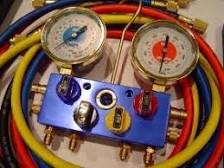
If you want to service the air conditioning system on your vehicle, here are some A/C service tools you may need: Gauge sets (2) One for older R12 A/C systems and one for newer R134a A/C systems. Two separate gauge sets are necessary because the hose connections are different, and you also want to avoid cross-contamination of refrigerants. A gauge set is used to read the high and low side pressures in an A/C system. These readings can provide essential diagnostic information for troubleshooting cooling problems. The gauge set is also used when recharging the system with refrigerant. Minimum requirements: The low pressure gauge should be capable of reading from zero to 30 inches of vacuum Hg, and zero to 250 psi. The high pressure gauge should have a range of zero to 500 psi.This is only required for professional repair shops, not do-it-yourselfers. Even so, it is illegal to vent ANY type of refrigerant into the atmosphere no matter who does it. Federal clean air regulations require the recovery and recycling of the refrigerant from a vehicle's A/C system prior to performing any type of service work that involves opening up the system.
Refrigerant recovery and recycling equipment must meet Society of Automotive Engineers (SAE) standards. In addition, different types of refrigerant must not be intermixed. This requires a separate recovery/recycling machine for each type of refrigerant used: one for R12, one for R134a (or a combination machine that includes separate circuits and storage tanks for R12 and R134a), one for R-1234yf, and one additional recovery machine for any other "alternative" refrigerants that may be used (this includes blended refrigerants as well as RVs & trailers using R-22). What's more, professional technicians who do A/C work must be "certified" as having successfully passed an EPA-approved training course on recycling and recovery procedures. This is NOT a requirement if you do your own repairs. Thermometer for measuring air temperature at the A/C outlets to diagnose cooling performance. A thermometer should be capable of measuring air temperature from 20 degrees up to 100 degrees Fahrenheit.
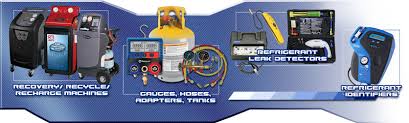
A non-contact infrared thermometer is also a useful tool for measuring the surface temperature of A/C hoses, the condenser and radiator. Leak detector or leak detection dye to find refrigerant leaks. It is pointless to recharge an A/C system if it has a leak. It may work for awhile, but sooner or later the refrigerant will leak out again. The least expensive and easiest way to find leaks in your A/C system is to add dye to the system. After several days it will leak out and leave telltale stains where the system is leaking. Many dyes are fluorescent and will glow bright green or yellow when illuminated with an UV light. Electronic leaks detectors typically cost several hundred dollars and are too expensive for most do-it-yourselfers. But electronic leak detectors are good for finding leaks in hidden areas that are difficult or impossible to see directly (such as an evaporator leak inside the HVAC unit). Sensitivity depends on the model, but most can detect leaks as small as 0.1 to 0.4 ounces per year.
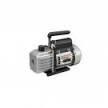
Vacuum pump for purging air and moisture from the A/C system prior to recharging it with refrigerant. The pump should be capable of pulling a minimum of 29.5 inches of vacuum Hg. (This is included in almost all recovery and recharging stations.)
types of ac distribution systemThe A/C system also has to be purged if you open any hoses to replace any parts.
hotel motel heating cooling unitsAir and moisture get inside.
no power outside ac unitAir displaced refrigerant and can reduce cooling efficiency, while moisture can form acids and sludge that can damage the compressor and other metal parts. Refrigerant identifier is an expensive tool that many repair shops use to identify and verify the type of refrigerant in a vehicle's A/C system before they service it.
This reduces the risk of cross-contaminating their A/C recovery/recycling equipment. The more sophisticated equipment will even reveal the exact percentages of various refrigerants and contaminants in the system. But these are expensive tools, costing over $1500 or more. So if you suspect bad refrigerant, take your vehicle to a shop that has one of these machines and have them check your refrigerant for contamination. CAUTION: Flammable refrigerants such as propane or butane (which are illegal to use in mobile A/C systems) are dangerous and pose a serious explosion hazard if there's a leak and something ignites the fumes. A shop may refuse to service your vehicle if your A/C system contains a flammable gas. EPA-approved certification programs for A/C technicians are available through numerous industry and aftermarket sources. These include the Mobile Air Conditioning Society (MACS), the International Mobile Air Conditioning Association (AMACA), the National Institute for Automotive Service Excellence (ASE), plus various service equipment manufacturers and vehicle manufacturers.
The certification programs cover the use of recycling equipment in compliance with SAE Standard J-1989, the regulatory requirements for recovery and recycling, the importance of preventing refrigerant contamination, and the effects of ozone depletion. To become certified, a technician must study a workbook and pass a written exam to demonstrate his knowledge of these subjects. The MACS workbook, for example, is 40 pages long and has a 25 question exam. A list of approved certification courses can be obtained by calling the EPAs Ozone Hotline at 1-800-296-1996 or by visiting their website at www.epa.gov/omswww (PDF file - requires to view). More than any other system in the vehicle, air conditioning requires special tools to do even routine maintenance. Add in the difficulties of dealing with an invisible gas in a closed pressurized system and it’s easy to see why so many people leave AC service to the pros. But, with the proper tools from Eastwood, there is no reason to fear AC anymore.